
The answer is “yes”, if we have free will.
This was Kevin J. Mitchell and Anil Seth chatting about free will. Are we programmed to inevitably act the same way based on some stimulus, or do we have a free choice?
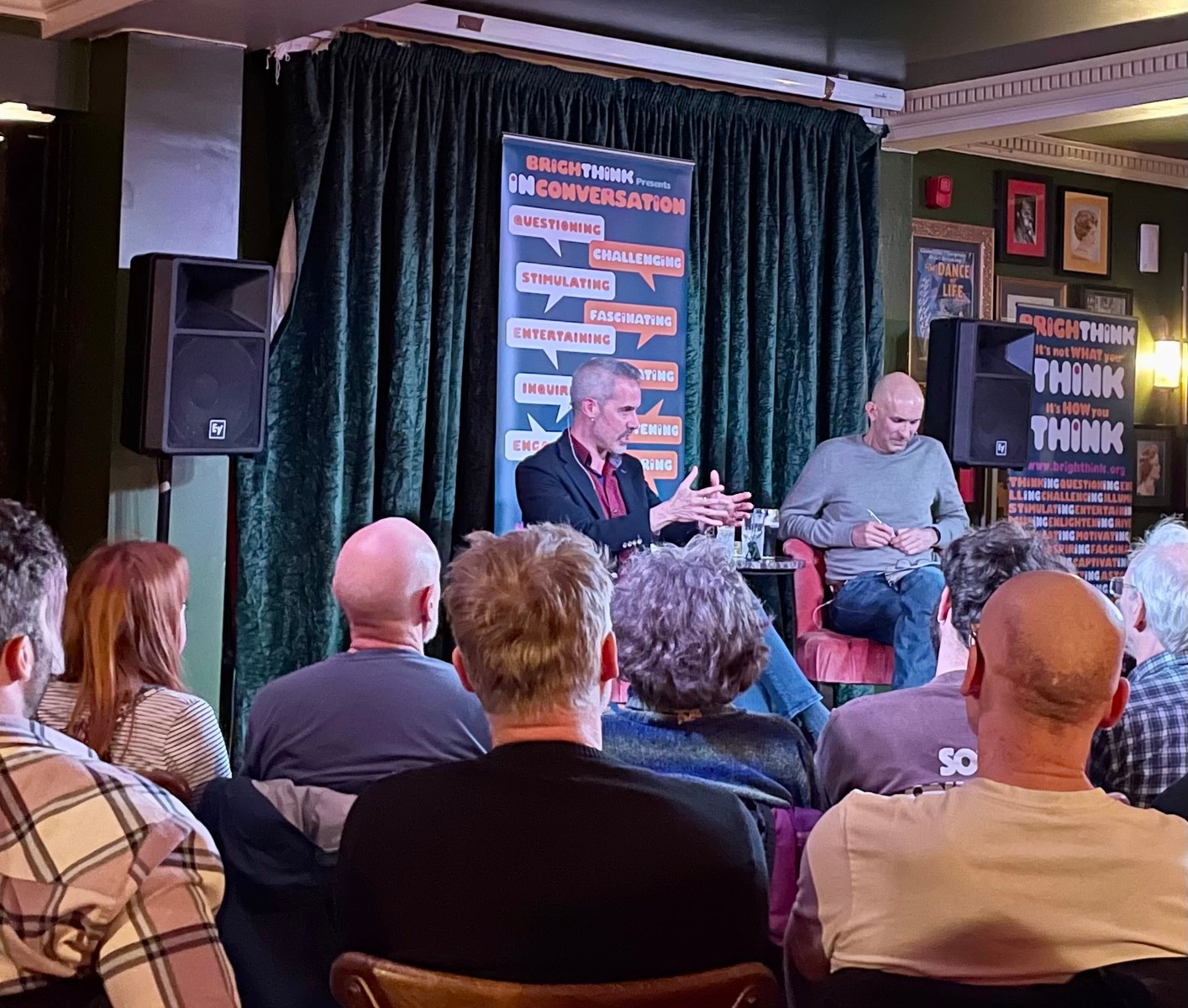
The problem, right from the start, is what “we” means in “do we have free will?”. After all, looking at the brain, it’s all molecules and atoms and whatnot following physics, so how can that have a choice?
That thought is in contrast to the experience of free will: “I” am the cause of that action, which aligns with “my” beliefs, and “I” could have done otherwise. We have “agency”. We can act in the world, avoid being eaten, and this is the basis of what life is.
We have some options:
- We don’t have free will, because all mechanisms are deterministic.
- Free will is our experience of a deterministic world (“compatibilism”)
- We do have free will in the sense that thoughts have a real role in our life—they “push stuff around” in the mind, giving us options.
This event didn’t touch much on option 1.
For 2, Anil Seth described an angle where being able to ascribe the outcome of an action to some choice is beneficial, but it doesn’t mean we have actual free will. That is, if we rewound time, we’d pick the same choice. That’s useful to have an experience of free will, because I can learn from what happened and next time I might (involuntarily) pick a different route. It’s a kind of reinforcement learning, if that’s a phrase you’re familiar with.
On 3, the argument is that free will isn’t an illusion and plays an important, causal, role in the way we act in the world. It comes about in a determinist(-ish) world because of the way we constrain physics. An analogy: the electrons in an iPhone are obeying the laws of physics, but they are constrained by the design of the device. It still makes sense to talk about features above the level of atoms. For living things, the same is true but via evolution. A bacterium is staying a live, using the same laws of physics as things which aren’t alive, but the way it is arranged “constraints it” to keep on living. For humans, it’s psychology where the action on choice is at. We can reason about our reasons.
That was a useful event for me to get a handle on the topic. In particular, determinism—if that’s even a good characterisation of the world—isn’t relevant to the topic.
* * *
This event is now somewhere on the list of Brighthink audio recordings, meaning you can give it a listen.