
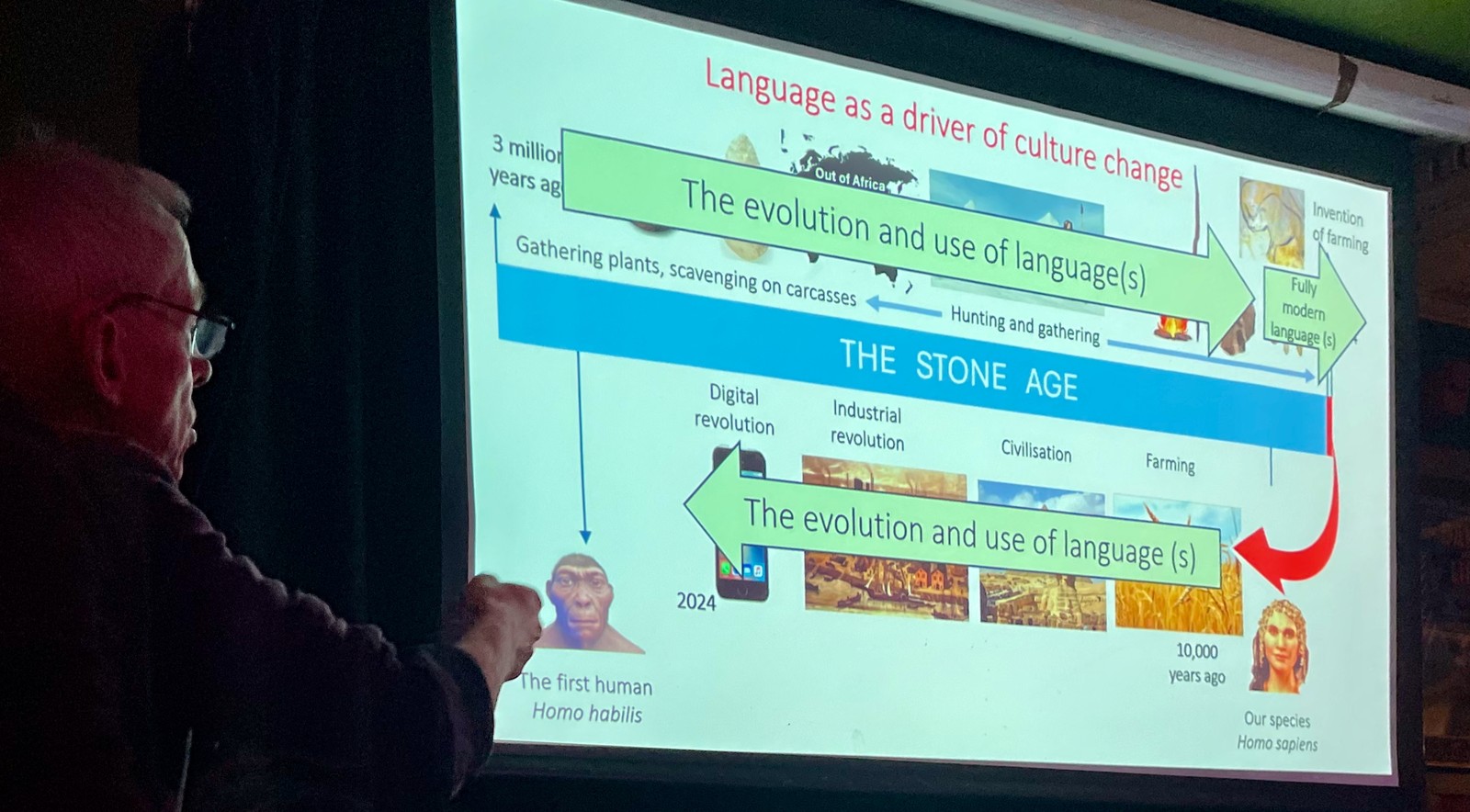
I dropped in to The Language Puzzle: How We Talked Our Way Out Of The Stone Age, a talk by archaeologist Prof. Steven Mithen. He’s a very compelling speaker, and gave a tour of how he believes language got started.
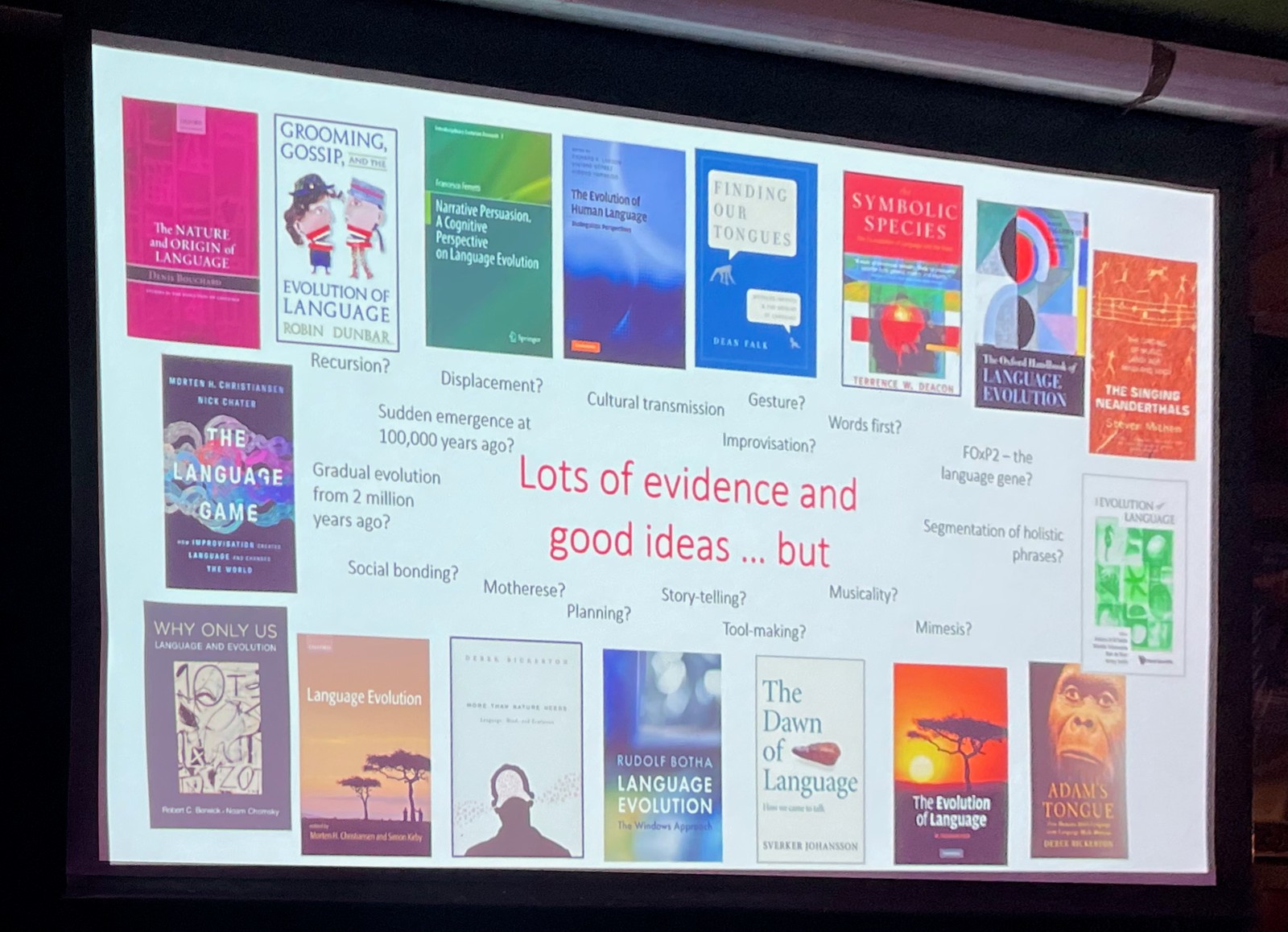
In outline: there was gradual word adoption, but a change in brain structure enabling a fully modern language to appear. From then on everything changed.
The timeline goes like this. From around 4 million years ago, our early ancestors had the ground work for language in “holistic calls”. There are no words, there’s no grammar, there are calls like chimpanzees make today.
Around 2 million years ago, Homo habilis started to use “iconic sounds”. These are sounds capturing the impression of an object. The evidence here leans on the Bouba/kiki effect: “when presented with nonsense words, [people] tend to associate certain ones (like bouba and maluma) with a rounded shape and other ones (like kiki and takete) with a spiky shape.”
From 1 million years ago we have arbitrary words for specific entities (animals, places, things generally). I presume this is an inevitable step for a social group that has iconic sounds in place, as we like playing with sounds and words.
The big breakthrough was the “globularisation of the human brain”. Neuroscience and genomics suggests the brain changed shape, becoming rounder (“globular”) increasing in size and connecting more areas of the brain.
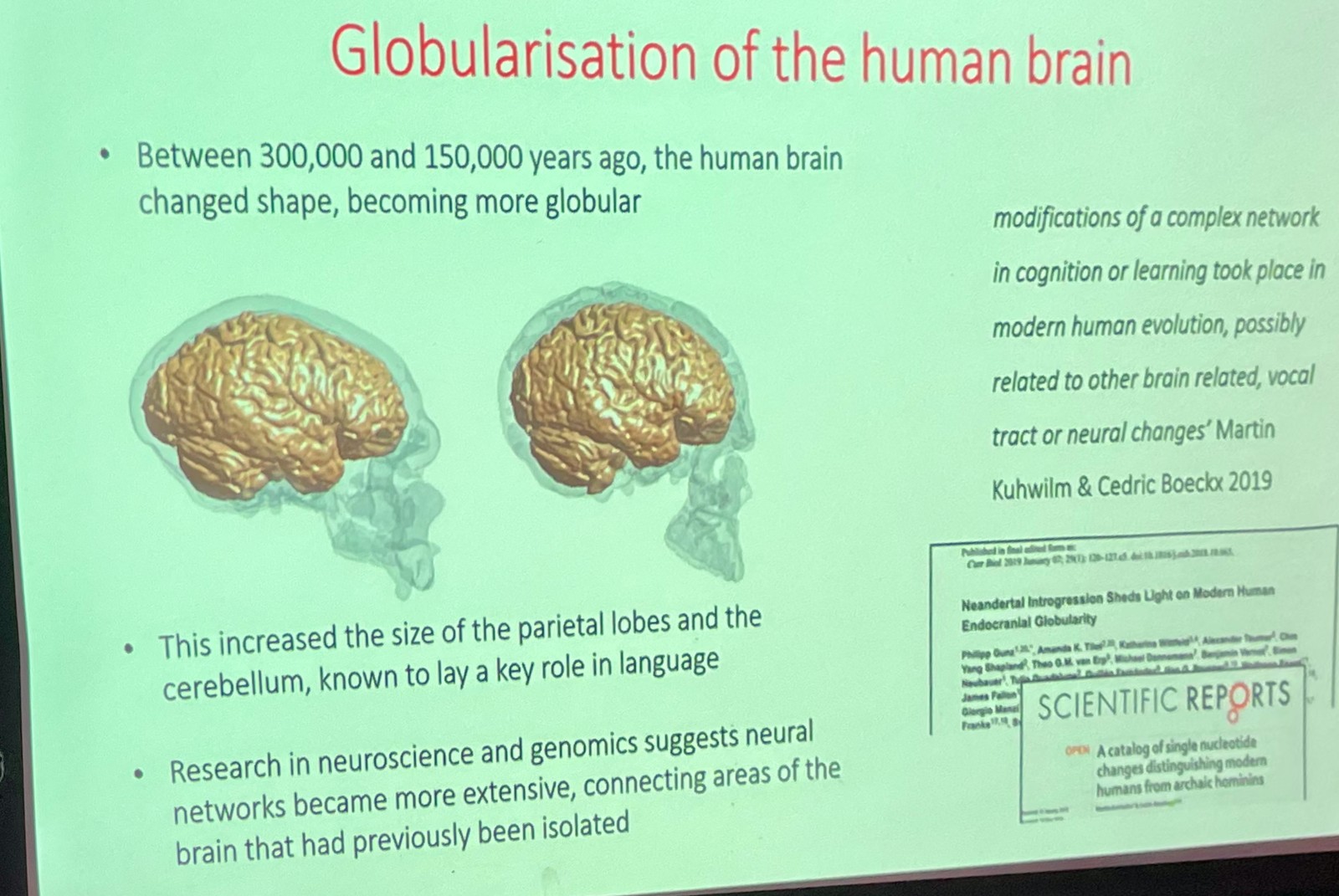
This, perhaps, opened the door to abstract words and metaphors, and helped drive the development of our species.
The conclusion to the talk:
By 100,000 years ago, people simply could not help themselves from talking about the world around them, about their relationships and new ideas. Nor could they help themselves with having fun with words.
With such constant talk and chatter, dialogues and gossip, speeches, conversations and tête-à-têtes, it was inevitable that new concepts would arise, inventions be made, and lifestyles would change. It remains the same today.
* * *
The references for globularisation are: Gunz et al (2018) Neandertal Introgression Sheds Light on Modern Human Endocranial Globularity and Kuhlwilm & Boeckx (2019) A catalog of single nucleotide changes distinguishing modern humans from archaic hominins.