
Reading: Nerd’s Eye View: 13 things you need to know about daylight saving time, The New World, 22 October 2025.
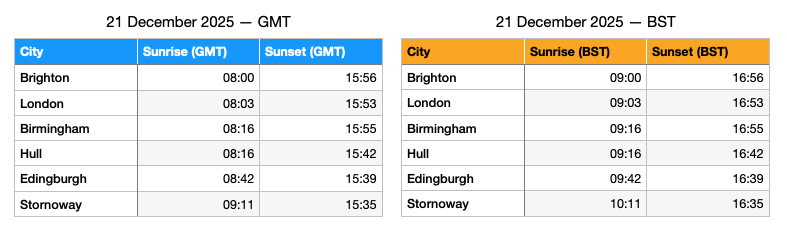
In March 1968, Britain’s clocks went forward but were not put back until October 1971. The experiment was abandoned because it wasn’t really clear whether it actually worked better, and some people, most notably in Scotland, complained about getting up in darkness each winter.
Well, yes, if it was dark until 10am I'd be complaining too.
It seems road traffic accidents were the main measure in this experiment, which is complicated given there was a change in drink-driving legislation passed in 1967 (noted by The Scotsman in "Mixed results from 1968 time experiment", 29 October 2011). But overall, with later analysis, the experiment did save lives.
The experiment ended, and British Standard Time was abandoned in 1971. From that I can tell, people just didn't like it.
The BBC has an audio feature capturing the news of a child being hit by a car in the morning darkness. "And so, with one tragic death, public opinion started to swing against it". Builders, milk carriers and farmers complained too.
A report at the time (Cmnd 4512, Review of British Standard Time) couldn't give an answer one way or another. I've not tracked that report down yet, but it is cited in British Summertime: Time to Decide?—an interesting research briefing from 1993 on the arguments for switching to Single/Double Summer Time (SDST), also known as Central European Time.
Anyway: Hansard records the debate, and it includes the results of a survey. The question, put in February, was: "In winter, which is more important to you—to have more light in the morning or more light in the afternoon?".
- Morning: 56%
- Afternoon: 32%
- Don't care: 12%
Of the 88% who had a view, 56% wanted to go back to a daylight saving system, and 13% wanted to continue the new system.