
Reading: Immunological sin: how a person’s earliest flu infections dictate life-long immunity, Nature, 17 December 2025.
The term OAS [original antigenic sin] comes from researchers who, in the 1950s, recognized that most of the flu-binding antibodies circulating in people’s blood match whichever influenza strains were most prevalent during their childhood.
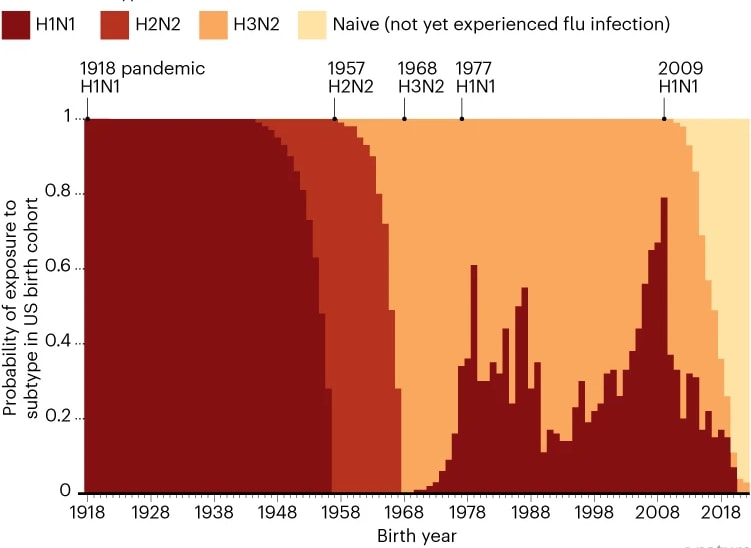
Possibly, your immune system may have a bias towards one kind of flu depending on when you were born. The graphic in the article is striking:
During Covid times I read Pale Rider: The Spanish Flu of 1918 and How it Changed the World which explains:
Every flu pandemic of the twentieth century was triggered by the emergence of a new H in influenza A: H1 in 1918, H2 in 1957 and H3 in 1968.
And that's what we're seeing in the graph. There was a pandemic in 1968, but I don't know why the exposure is mixed going into the 1970s. A Harvard Gazette post from 12 January 2026 notes this mixing, but doesn't explain it: "In 1977, H1N1 reappeared, but rather than taking over, it has been co-circulating with H3N2 ever since."
Aside from the graph, what I found interesting about the science is the idea that you might prioritise vaccinations by age. For example, if you know one age group doesn't have the imprinting for some new pandemic, it might make sense to focus on them first.