
Reading: Dietary restriction or good genes: new study tries to unpick which has a greater impact on lifespan, The Conversation, 17 October 2024.
Caloric restriction sounds intolerable. Cutting food by 30% or 40% to live longer doesn’t sound worth it. But does it improve healthspan?
On lifespan, it works, but not as well as just having the luck of good genes.
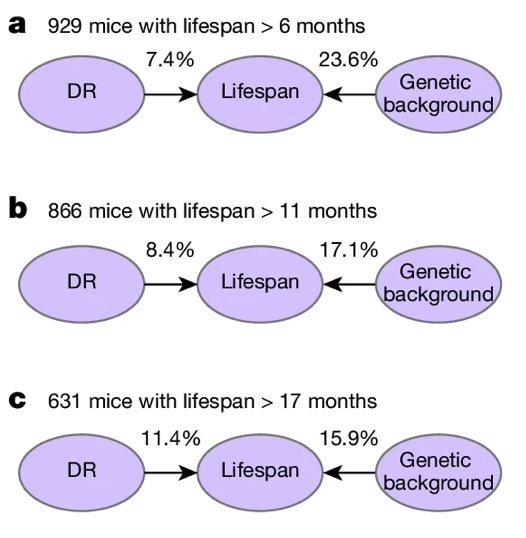
To get the most benefits, these mice need to be on the more extreme end of DR:
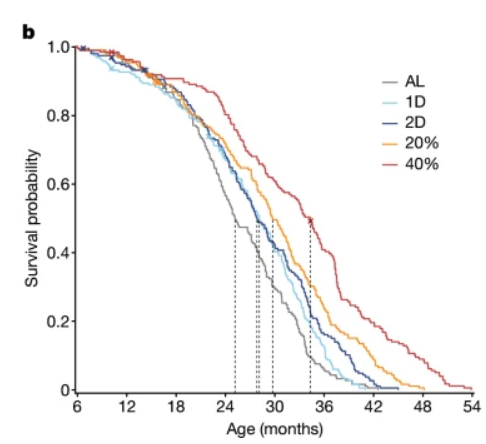
There are costs to this, in that it might be that longer-lived animals were healthier on average. After all, why did they live longer on the first place? It does seem like there were less tumours, but immune function may be reduced, which is bad news. Overall, the “findings indicate that improving health and extending lifespan are not synonymous”.
In the peer review correspondence for the source paper, the authors answer the question of why they used female mice only:
Regarding the use of female mice, we had concerns about male mice fighting. When male DO [“diversity outbred” = genetically diverse] mice are cohoused, aggressive behavior can arise in ~10% of pens, and we were concerned that the incidence of aggression might be increased in resource-limited experimental groups, such as dietary restriction. Considering the cost of long-term housing and phenotyping, the possibility that DR could exacerbate aggression, and the potential for bias due to removing aggressive animals from the study, or loss of weaker animals due to fighting wounds, we chose to do a females-only study. While we acknowledge that this is not ideal because we will miss the opportunity to see sex differences, there are many studies that use only male mice. Our study tips the balance the other way.