
A heavy sadness when someone utterly brilliant dies. Inman Harvey was the coolest person at Sussex. He looked at things in a different way, and was super influential for me and many others. He carried all this gently, always relaxed, generous, and never assuming he was right. He just seemed up for the adventure of trying things out.
* * *
I have very few photos of my DPhil days at Sussex, late 1980s and into the 1990s. I have this one paperclipped to the front of a research paper from August 1991.
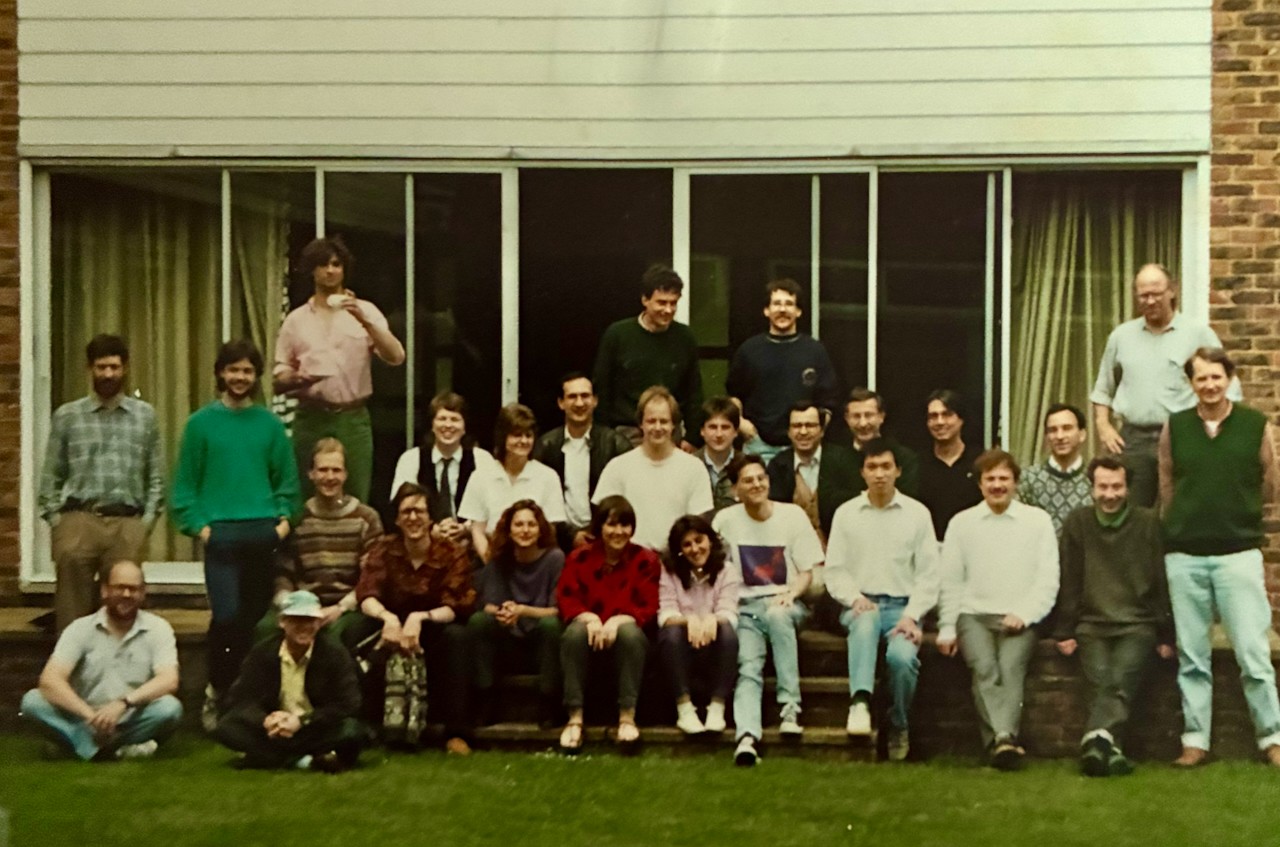
This was at the Isle of Thorns—Sussex University’s conference centre in the middle of nowhere—where postgrads would hang out for three days to present what they were up to.
* * *
I remember one project we did together. We entered the Santa Fe Double Auction Tournament around 1990. It was an automated trading challenge, and the attraction was trying out what we were working on. That, and the $10,000 prize money on offer.
I cannot remember much about what we did. I do remember sitting at a Sun workstation, looking out over campus, as we coded this up and letting it run. Beyond that, I don’t recall the details.
Fortunately, the organisers wrote up what we did in the Journal of Economic Dynamics and Control (1994, PDF). It says there that we submitted a recurrent neural network, which makes sense as that’s what I was working on. And we evolved the weights, which is what Inman was working on. We must have evolved the network against the default traders they gave us, or perhaps we co-evolved against our own system. I don’t know.
I do recall finding out I’d introduced a bug, which meant the trader made a loss. No share of the $10k for us. But we did better in a later re-running, making an improvement over their “zero knowledge” trader.
As we (perhaps Inman) put it:
Given that we are doing the equivalent of evolving monkeys that can type Hamlet, we think the monkeys have reached the stage where they recognize that they should not eat the typewriter. If we could have a 4 billion year time extension before handing in the entry, we are completely confident of winning.
Yup, that’s right, we’d nail it.
* * *
Everyone has a favourite Inman Harvey paper, surely? Mine would be The Microbial Genetic Algorithm, from around 1996. It’s an unconventional view of GAs, and you think: surely it can’t just be those ten lines of C? “GAs Stripped to the Minimum”.
If you’re not familiar with this work, you’re in for a treat. He’s left a treasure trove of writing to explore.