
Reading: Aging is not programmed: Genetic pseudo-program is a shadow of developmental growth, Blagosklonny (2013), Cell Cycle 12:24.
What are the causes of aging? Is it the accumulation of damage, or over-running healthy development? These are my notes on the paper.
Outline
We’re looking at ageing through the theory of “quasi-program” (also called “pseudo-program”). For comparison, a program is a system of changes that we need for development. It is selected for by evolution.
Aging is not a program in this sense (and the first part of the paper argues why that is). Instead, aging is the harmful, purposeless continuation of an actual developmental program that didn’t get switched off.
Aging is program-like. It is a quasi-program.
Why this happens at all goes by the name of the “antagonistic pleiotropy hypothesis” (pleiotropy is a term for a single gene having multiple effects). Roughly, the hypothesis means that evolution will favour genes that increase fitness in early life, even if they turn out to be harmful in later life.
Aside: An example of a quasi-program
Over in a separate paper, Why men age faster but reproduce longer than women (Blagosklonny 2010, Aging), a quasi-programe is contrasted to the “grandmother theory” of menopause:
…it was suggested that menopause in women is purposefully programmed to stop reproduction and to raise grandchildren instead.
There are problems here, including the assumption that group selection occurs. The alternative is that menopause is a quasi-program. A developmental programme that is running too long or inappropriately.
The cell cycle
At the cell-level, quasi-programs play out by continuing to stimulate growth.
The cell cycle describes the stages cells go through, resulting in cell division. There are various checkpoints in this process, and the cycle can be “arrested” (stopped):
When the cell is stimulated to grow, while the cell cycle is arrested, then the cell becomes senescent (geroconversion)
And what is triggering the arrest?
[…] cellular senescence can be viewed as a continuation of differentiation [where cells become specialised]. The same cytokines [small proteins, involved in growth] that initially cause growth and proliferation then cause cell cycle arrest and differentiation.
The normal genetic program for growth keep running and push cells into senescence. This leads to the diseases of ageing.
Features of quasi-program theory
Table 1 in the paper summarises differences between various theories of the mechanisms of aging:
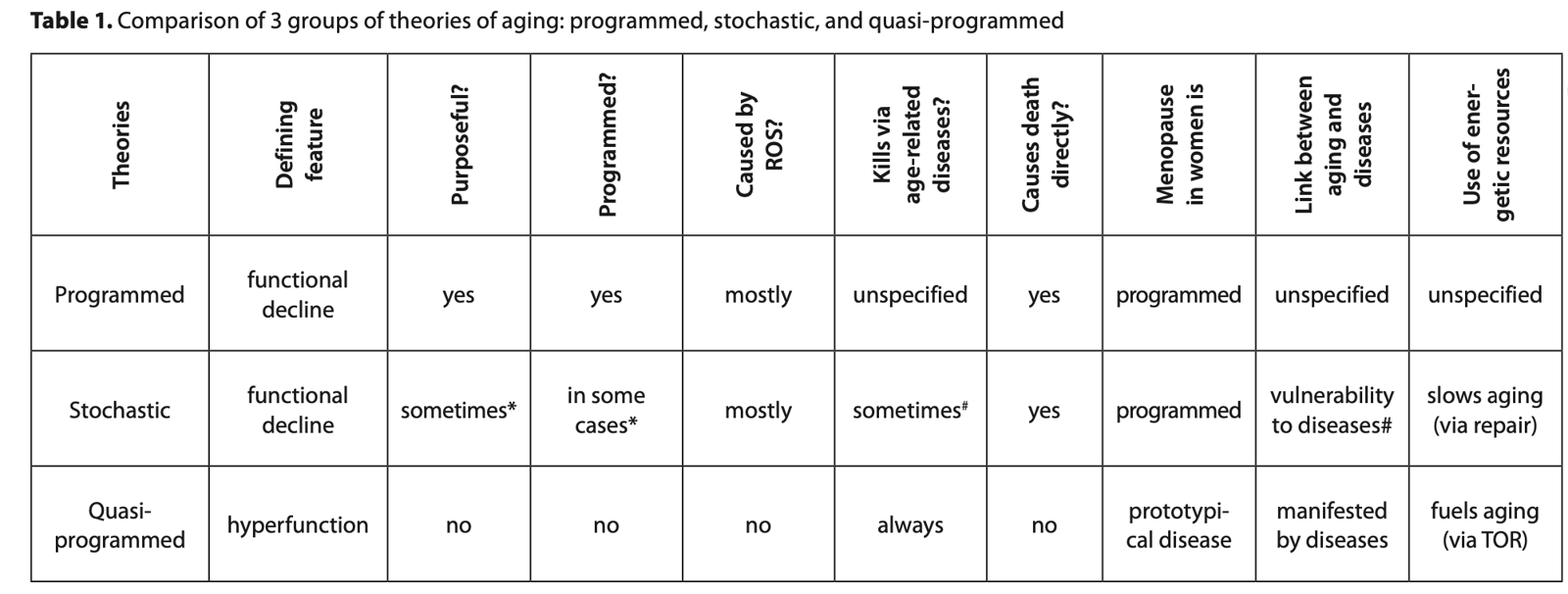
The defining feature of a quasi-program is the over-running we’ve discussed. This actively increases aging.
This is contrasted with stochastic change where the main feature is a functional decline. Our bodies try to repair damage to slow aging.
A positive outcome of quasi-program theory is:
Since development and growth are relatively well understood, we can interpolate this knowledge to studying aging.
The paper highlights a particular pathway around mTOR (a pathway sensitive to nutrients) noting:
Basically, genes that activate the mTOR pathway are gerogenes [genes that promote ageing], and those that antagonize the pathway are gerosuppressors [genes that suppress ageing]
Summary
I emphasize that the quasi-program does not exist for its own sake: it is a shadow. Aging has no purpose (neither for individuals nor for group), no intention. Nature does not select for quasi-programs. It selects for robust developmental growth. Accelerated aging is the price for robustness.
Programs are needed. It’s how we develop. We can’t stop that without adverse consequences. But there might be options to intervene once development passes certain stages.