
A recent podcast and a conference talk both addressed the topic of why we age. My summary: evolution has trade-offs to make.
Why we age and what we can do to stop it with Professor Richard Faragher
The Doctor’s Kitchen, 20th Nov 2024
There’s a succinct introduction near the start:
- aging likely evolved a billion years ago; and
- there are species that age, and species that don’t.
The definition of aging here is that your chance of death increases exponentially each year if you’re in an ageing species. It doesn’t increase—you have “negligible senescence”—if you’re a non-ageing species, such as mussels, Greenland shark, naked mole-rats and others. (Andrew Steele’s book, Ageless, goes into negligible senescence.)
Why the ageing/non-ageing difference? In the wild, there’s high “extrinsic mortality”. That is, something is going to get you sooner rather than later. Any mutations that are beneficial in older organisms aren’t going to get selected for, because all the reproduction action is biased towards the younger (more likely to be alive) individuals. It’s the “declining force of natural selection with time”.
Why we age, Michael Ringel
The 11th Aging Research and Drug Discovery meeting, 15 Nov 2024
This presentation looked at the theories of ageing, and the evidence for and against them.
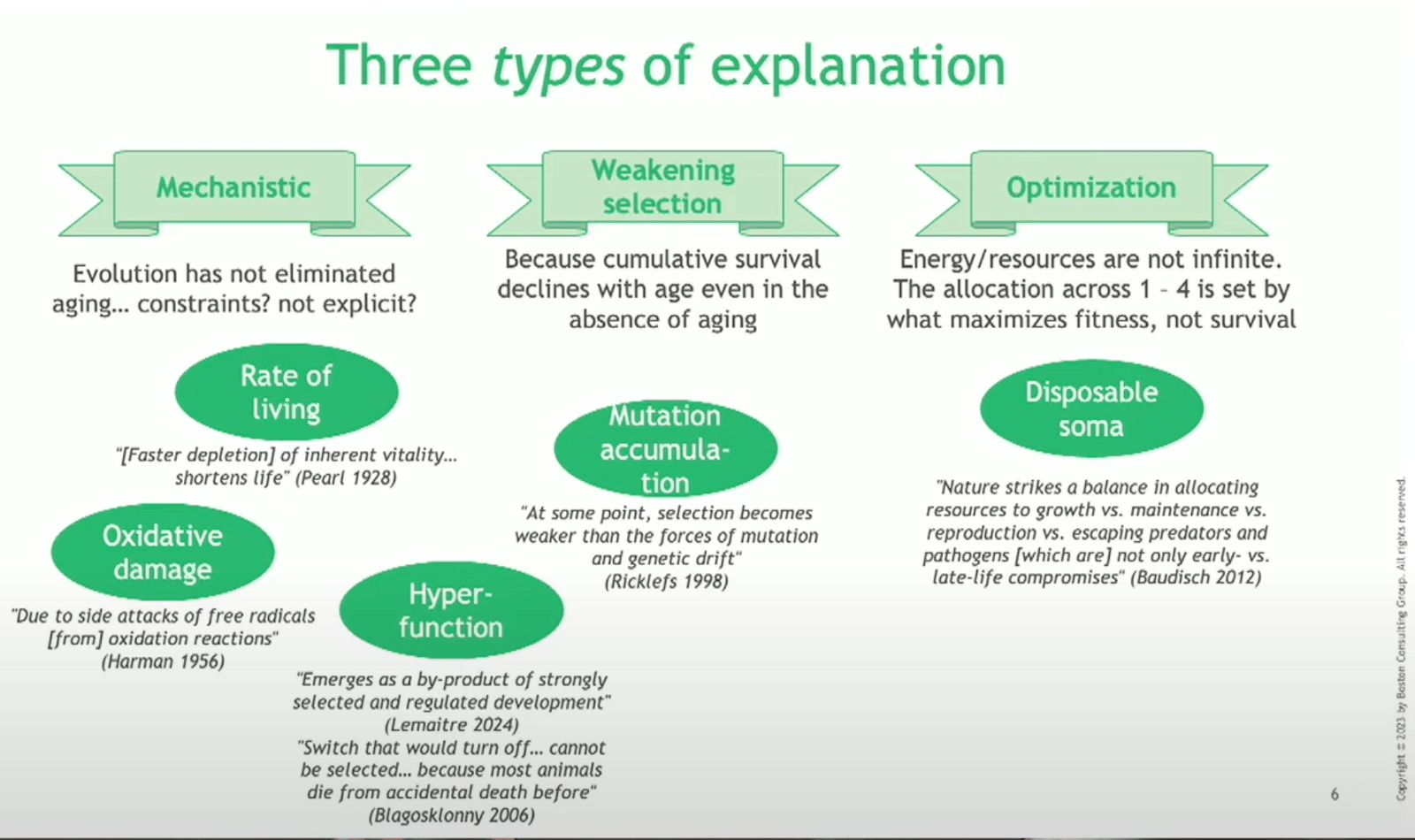
The conclusion is that it’s optimisation at work. It’s the one that best fits the data, based on the following metrics:
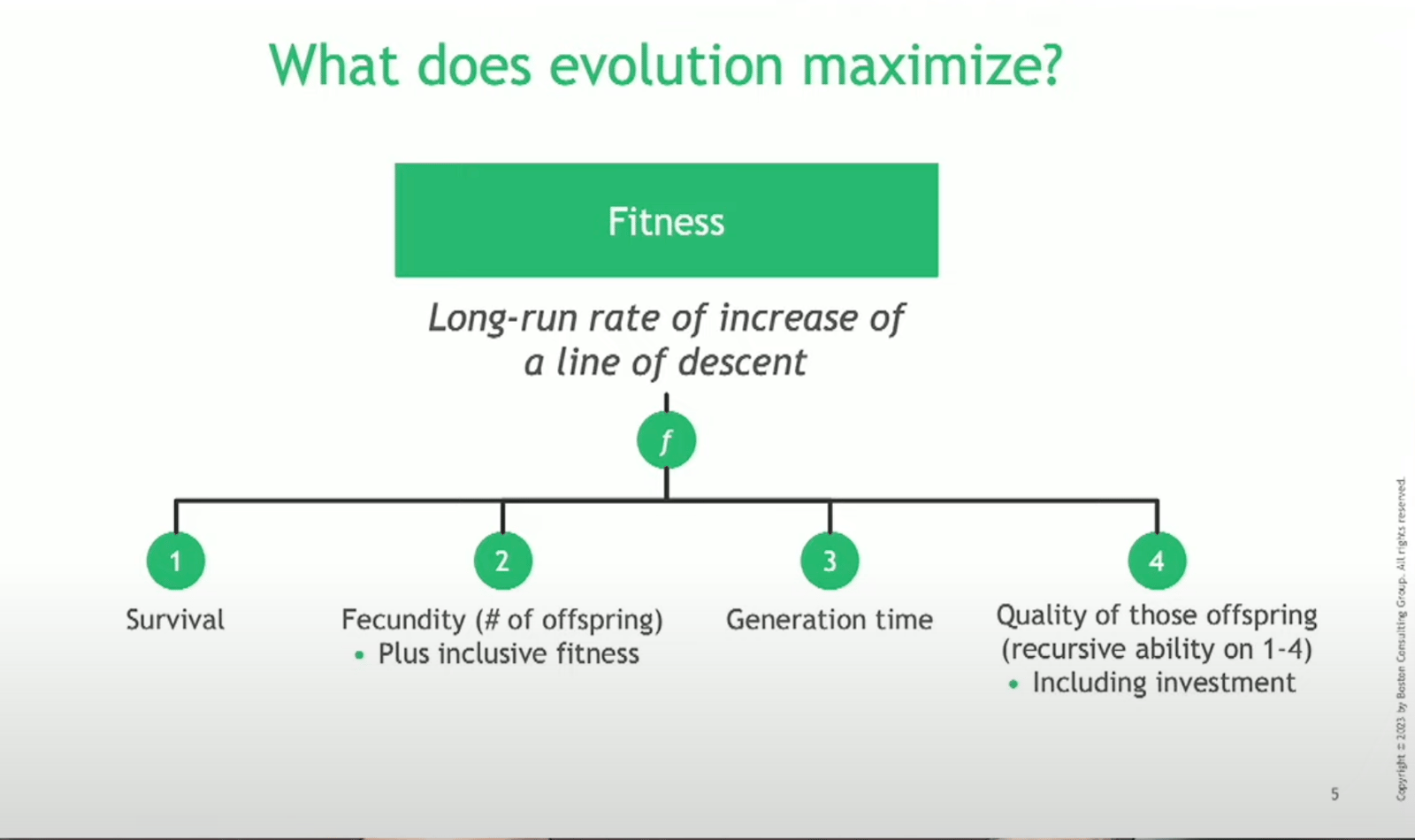
The thought is that species out in the wild are at a local maximum for their fitness. Any change (step in evolution) will reduce fitness—even changes that that increase lifespan.
Now, we do know there are mutations that increase lifespan, but they are hypothesised to reduce overall fitness and won’t be maintained in a gene pool. It’s a testable hypothesis, and someone will run that experiment.
I find this topic, and evolutionary thinking in general, super interesting, exciting and also super hard get my head around.